


A branding and website redesign should leave you with a coherent business presence and a website your team can actually operate.
That sounds straightforward until “branding” means a logo to one person, “website” means design files to another, and everyone assumes someone else is writing the content.
For an established business or funded startup, the scope is where you connect the commercial goal to specific work, owners, and approval decisions.
Here is what I would want clarified before starting a combined project.
Start with the change your business needs
Write a short description of the business problem before listing deliverables.
For example: “Our offering has expanded, but our identity and website still describe the company we were three years ago.”
Then identify the audience, the priority offering, and the action the website should help that audience take.
A leadership team seeking enterprise buyers may need clearer positioning and stronger evidence, while a company consolidating services may need a simpler structure.
Those are different projects, even if both end with a new logo and homepage.
Define what the project can deliver directly, such as clearer service pages and a working inquiry flow, separately from business outcomes that also depend on sales, traffic, and the offer.
Separate identity, website design, and implementation
These workstreams should connect, but they should never disappear inside one vague line called “full rebrand.”
Our NextDimension project pairs identity and website work, which makes it a useful example of how the same visual direction carries into a digital experience.
For your own scope, specify the responsibilities in three parts:
- Brand foundation and identity: agreed research, positioning or messaging work, logo system, typography, colors, and usage guidance.
- Website design: structure, page layouts, mobile behavior, component states, and the application of the identity.
- Website implementation: building the approved designs, connecting the CMS, configuring agreed integrations, testing, and launch.
If naming, copywriting, photography, motion, or additional collateral is required, list it explicitly rather than expecting it to be included.
Also identify who implements the website when the design partner and development team are different companies.
Count page types, content, and features
“A ten-page website” tells you less than it appears to.
Ten pages using one repeated service layout can involve different work from ten individually designed pages with different interactions.
Define unique page types, repeated pages, CMS collections, and the amount of content being entered or migrated.
A service page, case study, article, team profile, and resource directory each need different fields and editorial decisions.
Clarify whether filtering, search, gated downloads, multiple languages, or location-specific content is included.
For the CMS, agree which fields editors can change and which layout decisions should remain consistent.
A short inventory makes this tangible: six unique page types, twelve service pages using an approved template, twenty articles to migrate, and two forms to connect.
Those numbers are an example of scope detail, not a recommended package for every business.
Assign content and integration ownership
Content is often the dependency that turns an otherwise sensible schedule into an open-ended project.
State who writes, edits, verifies, and approves the copy, and when each group of pages needs to be ready.
Distinguish copywriting from placing supplied text into a layout.
List who supplies original photography, product screenshots, testimonials, and permission to use third-party material.
For integrations, name the system and the expected behavior: where a form submission goes, who receives it, and what confirmation the visitor sees.
Assign responsibility for account access, subscriptions, configuration, and testing with the receiving team.
“Connect the CRM” is incomplete until both teams agree what information should arrive and how they will confirm it worked.
Include the existing website in the scope
A redesign starts with an existing set of pages, links, and content that needs a destination.
Agree who inventories the current URLs and identifies which pages will remain, change address, merge, or be removed.
Where addresses change, include an agreed redirect mapping and implementation responsibility.
Also specify which page titles, descriptions, content, and analytics setup will be retained or updated.
Migration work should be a named deliverable, rather than something discovered after the new homepage is approved.
These are practical continuity tasks, not a promise that a redesign will preserve every ranking or increase search traffic.
Define approval gates and revision boundaries
Agree how a direction becomes approved before dependent work begins.
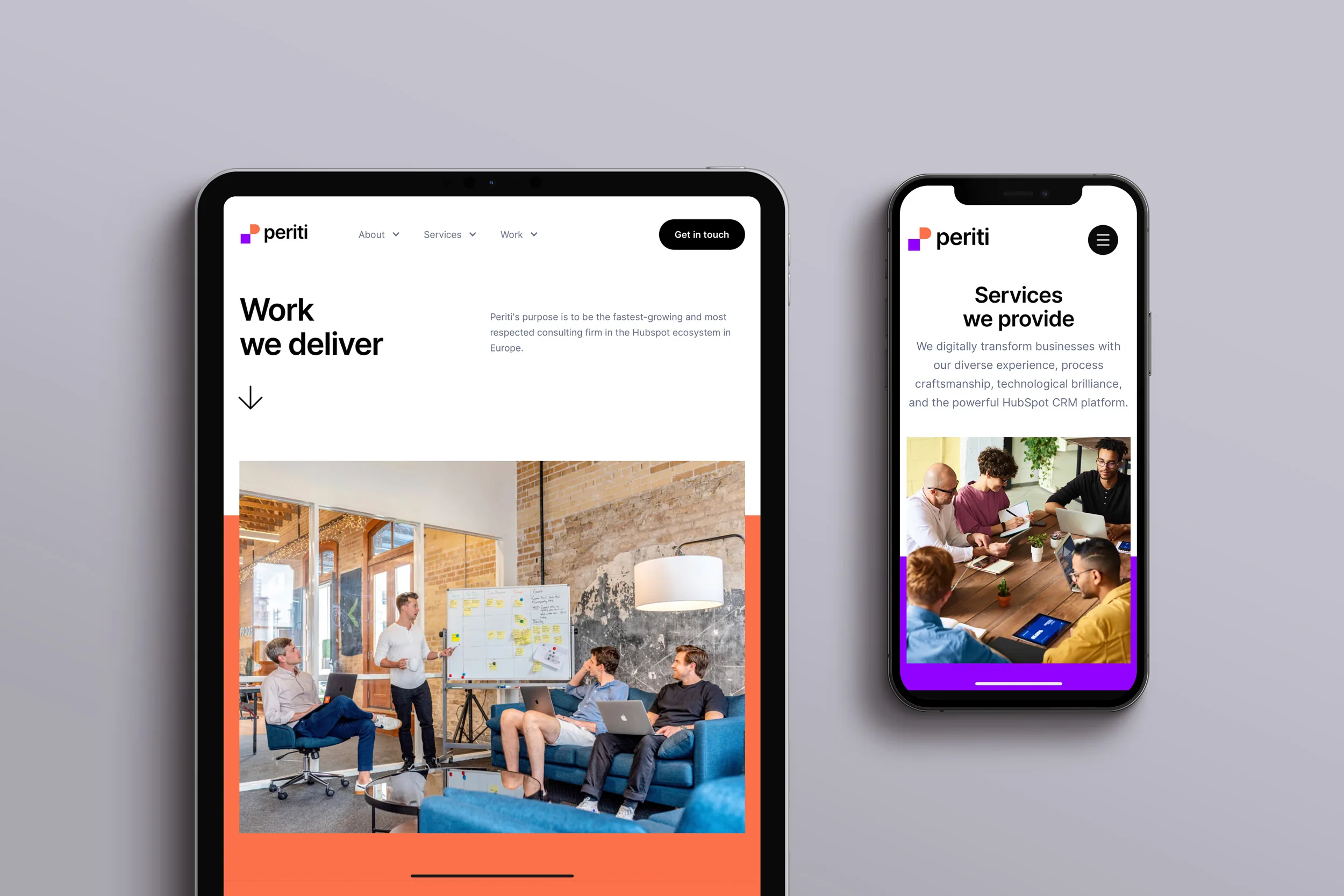
The Periti Digital identity illustrates why the underlying visual system matters beyond a standalone logo.
On a combined project, approving that foundation gives the website team a direction to apply consistently.
A useful sequence is brand direction, key website layouts, remaining templates, implementation review, and launch approval.
At each gate, identify the decision-maker, the review window, and the material being approved.
Ask for one consolidated response from the client team instead of conflicting feedback arriving through several channels.
Define included revision rounds and how a new direction after approval will be estimated.
A revision refines the agreed direction; a request for a different audience, additional service, or new feature may change the scope.
Show working time and calendar time separately
Several weeks of project work does not automatically mean launch happens the same number of calendar weeks after kickoff.
Interviews, leadership reviews, content delivery, and internal approvals can create gaps between working phases.
The schedule should show the active work, the client dependencies, and the target delivery dates.
If a launch date is fixed, plan backward from the required approvals and identify what can realistically be ready.
Show review periods and production phases separately so everyone understands the commitments.
Likewise, avoid treating every week of client review as a full week of design production.
A concrete scope example
Imagine an established B2B consultancy updating its identity and website after expanding its services.
An illustrative scope could include stakeholder interviews, a positioning summary, an identity system, a concise brand guide, six website page types, and implementation on an agreed platform.
It could also include migration of twenty approved articles, one inquiry form connected to the existing CRM, a URL migration plan, and an editor handover.
The client supplies approved service copy and photography, while the studio owns design and the agreed implementation work.
Naming, new photography, multilingual content, and ongoing campaigns sit outside that example unless added explicitly.
This is a way to describe boundaries, not a quote, delivery promise, or standard package.
Finish with acceptance and handover
Before launch, define the checks that determine whether the agreed work is complete.
Those might cover approved page content, responsive layouts, links, forms, CMS editing, agreed accessibility checks, and the migration tasks.
Name the test scope and owner rather than relying on a blanket statement that the site will be “fully tested.”
Handover should specify design files, logo exports, brand guidance, account ownership, editor training, and any operating notes.
Separate the period for correcting delivery issues from ongoing support, additional features, and future content changes.
Compare scopes before comparing totals
Use the same questions to compare two proposals:
- What business problem and audience does the work address?
- Who owns strategy, identity, copy, design, and implementation?
- Which page types, content quantities, and integrations are included?
- Who manages the old content and changed URLs?
- What are the approval gates, revisions, and dependencies?
- What is handed over, and what support follows launch?
A useful scope makes the next decision easier for both teams.
If you are planning a combined brand and website project, book a call and bring your current site, the business change behind the project, and any launch deadline.
We can use those inputs to define what needs to change and what the project should actually include.
Ready to build a brand people remember?
Tell me what you’re launching, changing, or trying to make look better.