


Web Design
SaaS Website Design Cost (2026 Breakdown)
Published on Nov 13, 2026
How much should you budget for a SaaS website that explains your product, earns trust, and helps the right visitors take the next step?
The answer depends on whether you need Figma design, a working website, or both.
I’m Arek, a branding and web designer, and I’ll walk you through the choices using real pricing evidence and my work for Elevate AB.
TL;DR: SaaS website design cost
A focused design handoff can cost a few thousand dollars, while a broader website engagement can cost much more depending on strategy, content, development, integrations, and the team involved.
For one real example, I charged $3,000 to redesign five Elevate AB pages in Figma; the client’s in-house engineers handled implementation.
My current monthly option is $10,000 for a month of dedicated design and development, with deliverables agreed according to the scope.
That is not a promise that every five-page design or complete SaaS site fits either price.
For a wider market reference, Clutch says most web design projects reviewed on its platform cost under $10,000, while its average is about $38,105; its sample covers web design generally, not only SaaS sites.
A larger, custom engagement can reach $50,000 to $100,000 or more, but that is one end of a broad market, not the standard price for every agency.
The clearest next step is to agree on what must be delivered and who will build, edit, and maintain it.
Table of contents
- What does a SaaS website cost?
- Design versus development
- A real example: Elevate AB
- What changes the price?
- Freelancer, senior expert, agency, or in-house?
- Can AI and components reduce the cost?
- How to plan your budget
- How long does it take?
- Questions to ask before hiring
- Frequently asked questions
What does a SaaS website cost?
The numbers below are reference points, not interchangeable quotes, because their sources measure different markets and services.
| Route or reference | Published number | What it does and does not tell you |
|---|---|---|
| Marketplace web designers | $15–$30/hour median on Upwork | A marketplace-wide web design benchmark, not a quote for a senior SaaS specialist or a complete build. |
| My Elevate AB design handoff | $3,000 | Five pages designed in Figma; the client’s engineers implemented them. |
| My dedicated month | $10,000 | Design and development capacity for an agreed scope; software and third-party costs are separate. |
| Clutch-reviewed web design projects | Most under $10,000; approximately $38,105 average | General web design projects in Clutch’s review dataset, not a SaaS-only price list. |
| Large, custom agency work | $50,000–$100,000+ | Possible for broader or more complex work; do not assume every agency charges this. |
Upwork reports a $15–$30 median hourly range for web designers on its platform, and experience, location, specialization, and responsibilities affect any individual quote.
Clutch’s web design pricing guide reports both the sub-$10,000 majority and the higher average, which is a reminder not to treat one number as the market price.
WebFX’s survey-based guide also describes a wide spread and says larger businesses sometimes spend $100,000 or more on design.
The $50,000–$100,000 range can make sense for an engagement with a larger team, extensive research, many templates, content, and a complex build, but the actual proposal should explain what is included.
Do not multiply a marketplace hourly rate by a guessed number of hours and treat the result as a reliable fixed quote.
Design versus development: what are you paying for?
A design-only engagement usually produces layouts, components, visual direction, and a handoff that someone else must implement.
Development turns those decisions into a working site with responsive behavior, navigation, forms, and the agreed content system.
A quote for design alone should not be compared directly with a quote that also includes a live build, migration, integrations, testing, and launch.
Ask for the deliverables in plain language: which page designs, which breakpoints, which working pages, and which team owns each step.
If your engineers will build the site, include their time and availability in the total budget even when their salaries are already accounted for.
If you need someone to build it, confirm whether the proposal covers design, implementation, QA, launch, and a handoff your team can actually use.
A real example: Elevate AB
For Elevate AB, a Shopify A/B testing platform, I redesigned five website pages in Figma for $3,000.
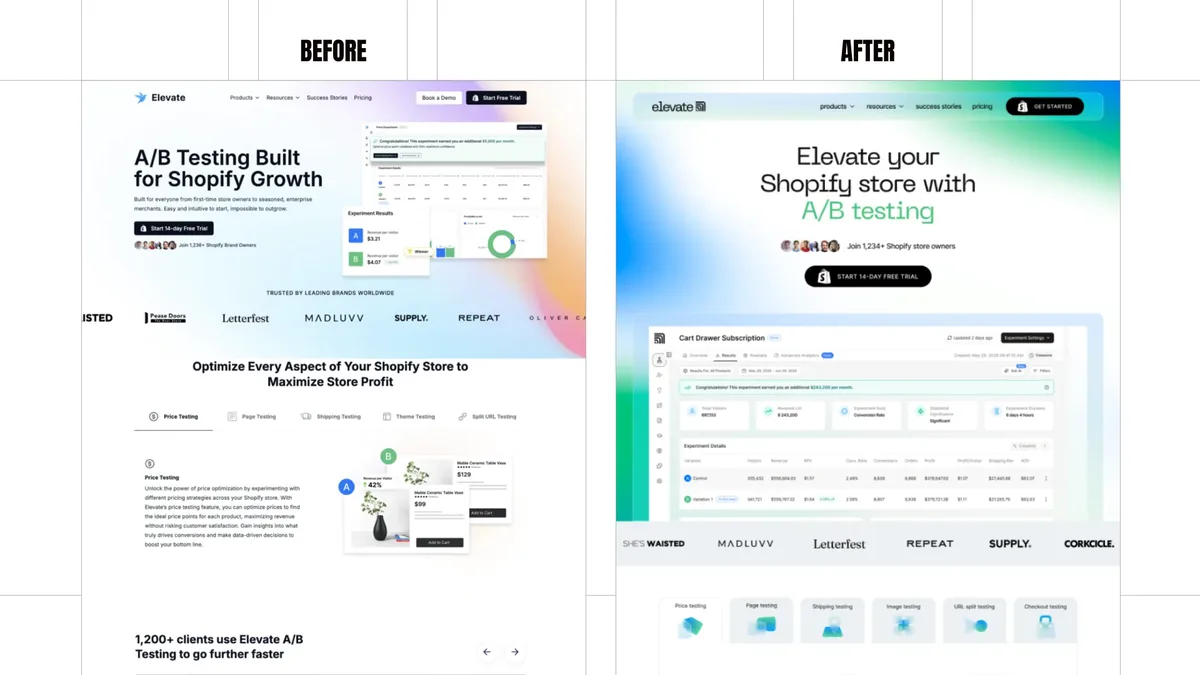
I used the Relume Figma kit to establish the page structure, then adapted the visual design to the brand and the content.
I handed off the designs and workflow guidance; Elevate’s in-house engineers implemented the site using matching Relume React components and Claude, guided section by section.
Human art direction and corrections remained part of the process, because generated code still needs someone to check the design and make decisions.
The $3,000 covered the design handoff described here, not a full development engagement, and it should not be treated as a universal five-page package.
The comparison shows a change in visual presentation; I am not claiming a measured conversion or revenue lift from it.
A consistent identity helps the site feel like the product
The website design also sat alongside a broader Elevate identity project.
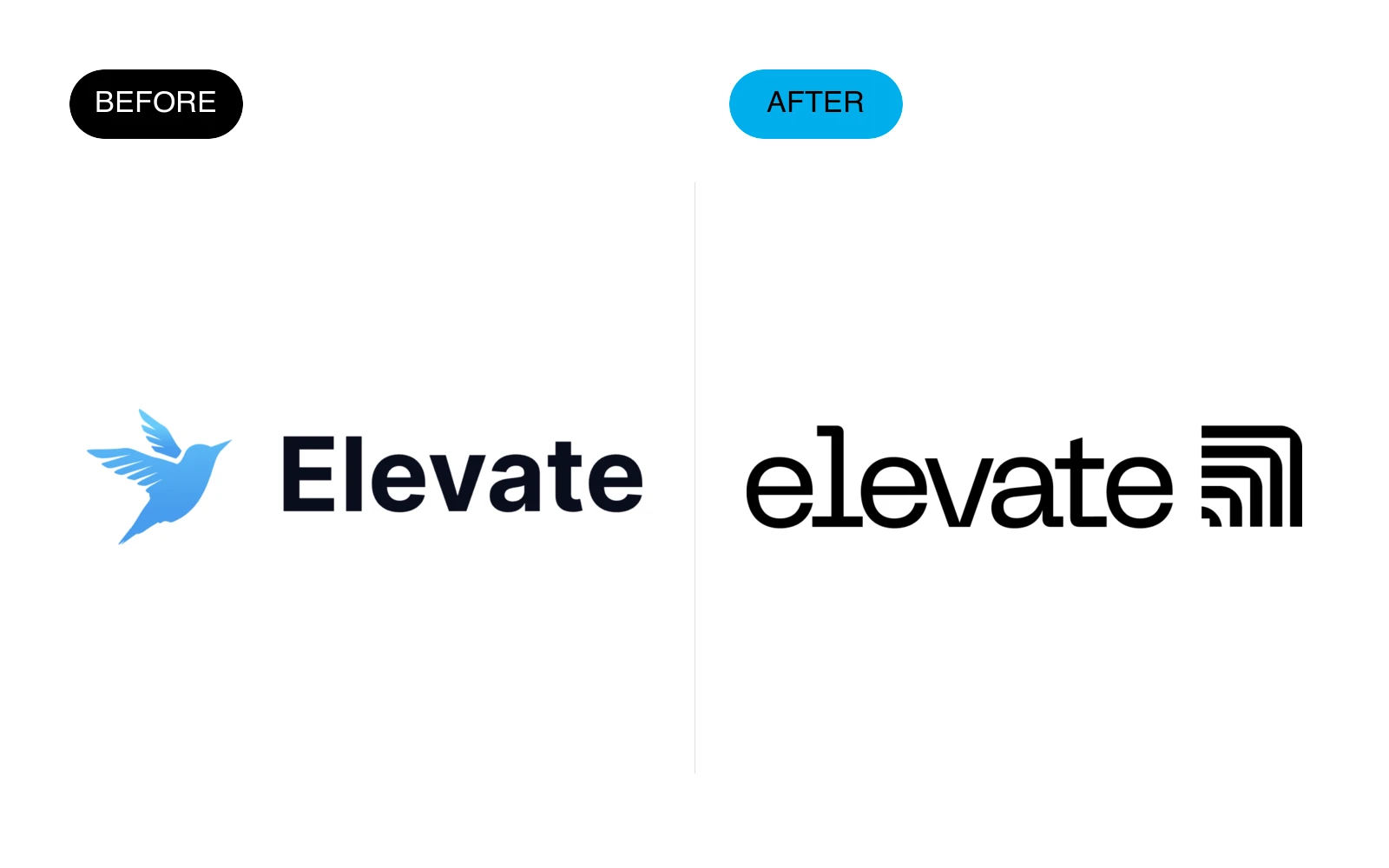
A visual identity gives the website a shared vocabulary for typography, color, imagery, and the product interface.
If that foundation needs to change, scope the identity work separately instead of assuming it is included in every website quote.
You can see more of the identity and website in the Elevate case study, read my web design process, or explore more SaaS website examples.
What changes the price of a SaaS website?
Page count matters, but it is only the beginning of the estimate.
1. Strategy and messaging
A team with a clear position, approved copy, and a defined offer can give a designer a more focused starting point.
If the product is hard to explain, you may need customer research, positioning, messaging, or copywriting before final design.
Those decisions influence the structure of a pricing page, product page, and homepage, so they deserve time in the scope.
2. Templates, pages, and content
Ten pages built from three repeatable templates are different from ten completely custom page designs.
Count the unique layouts as well as the number of published pages, and identify who will write and enter the content.
3. Visual system and product graphics
Existing brand guidelines and usable product screenshots can make a project more focused.
Custom illustration, product diagrams, UI mockups, motion, and photography add work when they need to be created or revised.
4. Platform and integrations
A simple marketing site can be built with a visual builder or a component-based codebase, depending on the team and the requirements.
A CMS, CRM forms, analytics, localization, gated content, or custom integrations add decisions, implementation, and testing.
The marketing website is also different from the SaaS application itself, which may require separate product design, engineering, authentication, and security work.
5. Migration, quality assurance, and launch
Moving an existing site can involve inventorying URLs, redirects, content, assets, metadata, and ownership of the domain and accounts.
Budget for responsive checks, browser testing, keyboard use, form submissions, performance, and a clear launch plan.
On-page SEO work can include titles, headings, metadata, and redirect planning, but no designer can promise rankings from a redesign.
Freelancer, senior expert, agency, or in-house?
Each route can be a good fit when its responsibilities match the project.
Freelancer
A freelancer can be practical for a defined design or implementation task, especially when your team can supply content and make decisions quickly.
Check the person’s SaaS work, availability, handoff process, and whether development or other specialists are included.
Dedicated senior expert
My model is direct collaboration with a senior designer who can also work on the website build when that is part of the agreed scope.
For a suitable team, fewer handoffs and a reusable component system can make the work efficient and cost-effective.
That efficiency depends on a focused brief, available content, timely feedback, and a scope one person can realistically deliver.
My $10,000 monthly option can cover dedicated design and development work, potentially including custom graphics, animation, responsive fixes, integrations, on-page SEO, and CMS work where agreed.
The exact combination, number of pages, and technical responsibilities belong in the proposal, and platform subscriptions and third-party services are separate.
Agency
An agency can be a strong choice when you need several specialists working together, extensive research, complex content operations, or coverage across a large program.
A larger team can also bring additional coordination, so ask who will do the work and how the scope is managed.
Agency prices vary widely; Clutch’s review data does not support treating $50,000 as a universal agency minimum.
In-house team
An in-house team understands the product and can maintain a site closely, but it still needs capacity for strategy, design, engineering, content, and quality assurance.
A hybrid model can work well when an outside specialist provides direction and the internal team owns implementation, as in the Elevate example.
Can AI and reusable components reduce the cost?
AI and component libraries can reduce repetitive production work, especially when the design and code share a clear structure.
For Elevate, the team used matching Relume Figma and React components and guided Claude one section at a time.
That workflow gave the engineers a concrete starting point, but it did not remove the need for design judgment, review, corrections, or testing.
A complex site still has real work: organizing content, agreeing on layouts, configuring a CMS, checking responsive behavior, and making the result reliable.
Use AI to support a defined process, and ask who is accountable for the final result.
How to plan a realistic website budget
Start with the launch outcome and separate the essential scope from later improvements.
- List the pages and identify which need unique designs versus reusable templates.
- Decide who owns strategy, copy, design, development, content entry, testing, and launch.
- Write down the CMS, forms, analytics, integrations, and migration requirements.
- Get separate numbers for one-time work, third-party subscriptions, and post-launch maintenance.
- Agree on review rounds, decision-makers, dependencies, and what happens when the scope changes.
For example, a team with approved copy and an in-house developer may commission a design handoff first, then budget engineering time separately.
A team without implementation capacity may prefer a combined design-and-build scope, with the platform, CMS, testing, and launch defined in writing.
Keep a contingency for changes discovered during the project rather than assuming every dependency will be known at kickoff.
How long does a SaaS website take?
I can design a few focused Figma pages in a week when the scope and inputs are ready.
A complex multi-page site takes substantially more work, especially when it includes original content, a CMS, integrations, migrations, or multiple stakeholders.
Clutch reports a typical project duration in its general web design review dataset, but that figure should not be read as a schedule for your SaaS project.
Ask for milestones for content, design, build, feedback, QA, and launch, and identify which dates depend on your team.
Questions to ask before hiring
A good proposal makes it easy to compare the work, not just the headline price.
- Who will do the actual design and development?
- Is the price for Figma files, a live site, or both?
- How many unique layouts and responsive states are included?
- Who writes copy, supplies product visuals, and enters CMS content?
- What integrations, redirects, testing, and launch tasks are included?
- How are feedback, revisions, and changes in scope handled?
- Who owns the files, code, domain, and platform accounts?
- What support and recurring costs should we expect after launch?
Frequently asked questions
Can I design a SaaS website for $3,000?
A focused design-only scope may fit, as the Elevate five-page handoff did, but a complete build or a different scope needs its own estimate.
Does $10,000 buy a complete website?
My $10,000 monthly option buys dedicated time for an agreed design and development scope, so we first define what can realistically be delivered within that month.
Are agencies always more expensive than freelancers?
No, because experience, geography, scope, and team structure vary, and a useful comparison requires the same deliverables and responsibilities.
Should we use Framer, Webflow, or a custom codebase?
Choose based on the editing experience, design requirements, integrations, existing engineering team, and ongoing ownership.
My platform comparison and web design process explain those choices in more detail.
What costs continue after launch?
Depending on the platform and scope, you may pay for hosting, a CMS plan, domains, software seats, integrations, maintenance, content updates, and future improvements.
Choose the scope before the price
A useful SaaS website budget starts with what the team needs to launch and who will own the work afterward.
If you want help deciding between a Figma handoff and a design-and-build engagement, see my web design service and pricing, or book a call.
Ready to build a brand people remember?
Tell me what you’re launching, changing, or trying to make look better.